

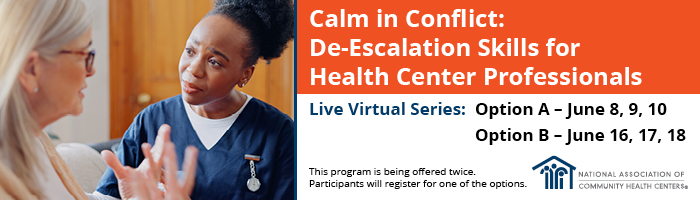
Calm in Conflict: De-Escalation Skills for Health Center Professionals
For: Patient-facing roles
Duration: 3 sessions
Registration: NACHC Member; $375
NACHC Non-Member; $750
Delivery Method: Live virtual
Schedule: June 2026
Pre-requisites and level: Novice, beginner
This training has been cancelled! Please check out our other available trainings.
Overview
Due to the sensitive nature of healthcare, it is common for health professionals to experience emotionally charged situations with distressed patients, frustrated family members, or between colleagues. These moments require the ability to defuse potentially volatile situations with confidence and compassion, maintaining safety and mitigating grievances.
"Calm in Conflict” is an interactive workshop designed specifically for health center professionals seeking practical tools to effectively de-escalate emotionally heightened interactions with patients and colleagues alike. Through role-play and guided reflection, participants will learn to recognize signs of distress, respond with empathetic communication, and use proven de-escalation techniques to reduce tension, build trust, and prevent harm.
Learning Objectives
Session 1: Understanding Escalation and Self-Regulation
- Learn to identify early behavioral indicators of escalation and agitation.
- Learn to observe, identify, and rapidly respond to internal distress when intervening with an escalated individual.
- Explore the benefits of remaining calm on nonverbal communication.
Session 2: Verbal De-escalation
- Learn to identify communication styles that can increase agitation and “resistance.”
- Practice using structured verbal responses that reduce perceived threat and defensiveness.
- Increase confidence using validation and choice without reinforcing ineffective and unsafe behavior.
Session 3: Burnout Prevention, Stress Reduction
- Explore and identify brief recovery strategies that can be used to target immediate and cumulative stress.
- Explore ways teams can support staff wellbeing after difficult encounters.
- Discuss and develop personal plans for maintaining control in high-stress environments.
Who Should Attend
Ideal for any patient-facing role, including front-desk staff, schedulers, outreach workers, enrollment staff, nurses, physicians, and allied health workers.